

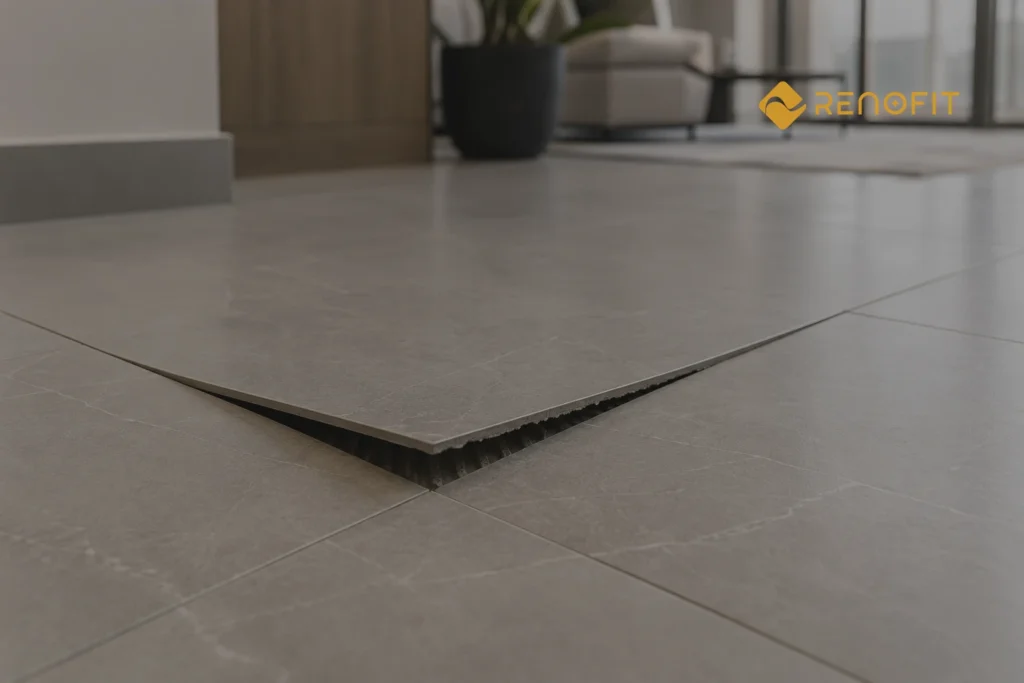
Have you ever tapped your floor tiles and noticed that some areas produce a hollow or empty sound while others sound solid? It may seem like a minor difference, especially when the tiles look perfectly normal from the surface. However, a hollow sound can indicate that the tile is not properly bonded to the surface beneath it.
For property owners, identifying this issue early can help prevent cracked tiles, loose flooring, moisture penetration, and unnecessary replacement costs. Renofit approaches flooring and renovation projects by considering not only the visible finish but also the condition of the surface beneath it, helping property owners make better decisions about repairs and upgrades.
What Does a Hollow-Sounding Floor Tile Mean?
A properly installed floor tile should have good contact with the adhesive or mortar bed beneath it. When you tap the surface, the sound is generally relatively solid because the tile is supported across much of its underside.
A hollow sound usually indicates that there is an air gap or insufficient contact between the tile and the underlying surface.
This can happen because of:
- Inadequate adhesive coverage
- Uneven flooring substrate
- Incorrect installation
- Movement beneath the tile
- Moisture-related problems
- Poor adhesive application
- Insufficient surface preparation
A hollow sound by itself doesn’t necessarily mean the tile has failed. The more important question is whether the tile is stable and whether other symptoms are developing around it.
Why Do Floor Tiles Sound Hollow?
1. Insufficient Adhesive Coverage
One of the most common reasons for hollow-sounding tiles is inadequate adhesive coverage.
If adhesive is applied unevenly or only to certain areas beneath the tile, sections can remain unsupported. These small air pockets produce the hollow sound heard when the tile is tapped.
This issue can be particularly important with large-format tiles because their size requires careful adhesive distribution and proper installation technique.
2. Poor Surface Preparation
The substrate beneath the tile needs to be clean, stable, level, and suitable for the selected installation system.
Dust, loose particles, old adhesive, grease, or other contaminants can prevent proper bonding. An uneven or deteriorating substrate can also leave gaps beneath the tile.
Good tile installation therefore begins before the adhesive is even applied.
3. Uneven Subfloor
A tile cannot compensate indefinitely for a poorly prepared floor.
When the underlying surface has significant variations in level, the adhesive layer may become inconsistent. Some sections may have adequate support while other sections remain partially unsupported.
Over time, foot traffic can place additional stress on these areas.
4. Incorrect Installation Technique
Tile installation requires more than spreading adhesive and positioning the tile.
The correct adhesive needs to be selected for the tile and substrate. It also needs to be applied correctly, at the appropriate thickness, with sufficient coverage across the contact area.
Incorrect installation techniques can result in weak bonding and premature tile problems.
5. Moisture Beneath the Flooring
Moisture can complicate an otherwise minor tile installation problem.
Water may enter beneath flooring through damaged waterproofing, plumbing leaks, failed grout joints, or moisture migration from surrounding areas.
Bathrooms, kitchens, balconies, utility rooms, and other wet areas deserve particular attention because persistent moisture can affect the substrate and bonding materials.
6. Building Movement
Buildings naturally experience small movements caused by temperature changes, material expansion and contraction, settlement, and other environmental factors.
If movement isn’t properly accommodated during installation, stress can transfer into the tiled surface.
This may eventually contribute to:
- Cracked tiles
- Broken grout
- Loose flooring
- Tile lifting
- Debonding
Proper movement joints and suitable installation practices help manage these stresses.
Is a Hollow Tile Dangerous?
Not necessarily.
A tile can sound hollow and remain stable for a considerable period. If there is no visible cracking, movement, moisture, or deterioration, the condition may not require immediate replacement.
However, hollow sound becomes more concerning when it is accompanied by other warning signs.
Look for:
- Tiles that move when stepped on
- Cracked tiles
- Cracked or deteriorating grout
- Raised tile edges
- Uneven flooring
- Damp patches
- Water stains
- Recurring moisture problems
A loose tile can eventually become a trip hazard, particularly in busy homes, offices, retail spaces, and commercial buildings.
What Happens If Hollow Tiles Are Ignored?
The main concern isn’t necessarily the hollow sound itself. The bigger issue is what may happen if the underlying cause continues.
Repeated foot traffic places stress on areas where the tile lacks adequate support. Over time, this can cause the tile to crack or break.
If grout joints also deteriorate, water can enter through the gaps. In moisture-prone areas, this may contribute to damage beneath the finished surface.
A small isolated defect may therefore become a larger flooring problem if it is ignored for too long.
How Professionals Inspect Hollow Floor Tiles
A proper inspection should look beyond the sound of the tile.
Visual Inspection
The flooring is checked for cracks, damaged grout, uneven surfaces, raised edges, movement, and visible signs of moisture.
Tap Testing
Systematic tapping can help identify areas where the sound differs from surrounding sections. This allows technicians to map potentially unsupported areas rather than relying on one isolated spot.
Moisture Assessment
If moisture is suspected, appropriate testing can help determine whether water is present beneath or around the affected area.
Substrate Inspection
Where necessary, a tile can be carefully removed to examine the adhesive layer and substrate beneath it. This can reveal problems such as poor adhesive coverage, surface contamination, cracks, or moisture damage.
The purpose of inspection is not simply to identify a hollow sound. It is to understand why the tile sounds hollow.
Can Hollow Floor Tiles Be Repaired?
The correct repair depends on the extent and cause of the problem.
Isolated Hollow Tile
If only one or a few tiles are affected and the surrounding floor is stable, individual removal and replacement may be appropriate.
Loose or Damaged Tile
A loose tile may need to be removed carefully. The underlying surface should then be prepared properly before installing a suitable replacement.
Multiple Hollow Areas
If hollow sounds are present throughout a large section, replacing individual tiles may only provide a temporary solution.
The substrate and installation system should be investigated to determine whether a larger repair is necessary.
Moisture-Related Problems
If moisture is responsible, repairing the flooring without addressing the water source can result in the same problem returning.
The moisture source should be identified and corrected before restoring the finished surface.
How to Prevent Hollow Floor Tiles
Good installation practices significantly reduce the risk of tile debonding.
Important considerations include:
- Proper substrate preparation
- Correct adhesive selection
- Adequate adhesive coverage
- Appropriate installation technique
- Correct tile positioning
- Proper joint spacing
- Adequate curing time
- Movement joints where required
- Moisture control in wet areas
The quality of the finished floor depends on both the materials and the installation process. Even an expensive tile can fail when the underlying preparation is poor.
When Should You Get Professional Help?
A professional inspection is worth considering when hollow areas are increasing or when other symptoms appear.
You should pay particular attention if:
- Tiles are moving under foot traffic
- Cracks are developing
- Grout repeatedly breaks
- Tiles are lifting
- Moisture is present
- Water stains appear nearby
- The affected area continues expanding
If the problem occurs in a recently renovated property, identifying the installation issue early may also prevent further damage and unnecessary replacement costs.
For larger renovation projects, an experienced maintenance company in dubai can assess the existing flooring, substrate, moisture conditions, and surrounding finishes before recommending the appropriate repair approach.
Repair or Replace: Which Is Better?
Not every hollow tile needs to be replaced.
The decision depends on the condition of the tile, the extent of debonding, the quality of the underlying surface, and the cause of the problem.
Repair may be suitable when:
- The problem is isolated
- The tile itself is undamaged
- The substrate is stable
- There is no continuing moisture issue
Replacement may be more appropriate when:
- Tiles are cracked
- Several areas are affected
- The substrate is damaged
- Moisture has caused deterioration
- The original installation was significantly defective
A proper assessment helps prevent unnecessary replacement while ensuring that serious underlying problems aren’t overlooked.
Conclusion
A hollow sound beneath a floor tile may seem insignificant, but it can sometimes reveal an installation, substrate, moisture, or movement-related issue. The sound alone doesn’t determine whether the floor has failed. What matters is the condition of the tile, the support beneath it, and whether additional warning signs are developing.
Regular inspection can help property owners identify loose tiles, deteriorating grout, moisture intrusion, and other flooring problems before they become more expensive to repair.
When flooring forms part of a wider property upgrade, choosing an experienced renovation company in Dubai can help ensure that the existing substrate and moisture conditions are properly assessed before new finishes are installed. Taking care of these details during the renovation stage can improve durability, reduce repeated repairs, and give the finished floor a longer service life.