

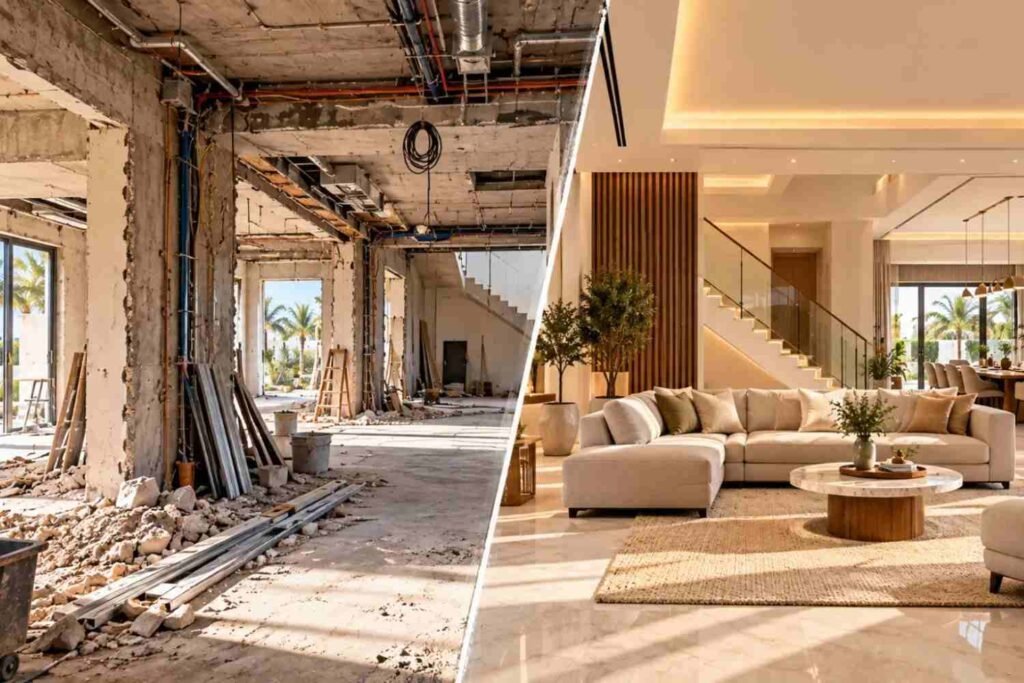
Villa renovation and villa remodeling are often used interchangeably, but they don’t always mean the same thing. Both can improve an older or outdated property, but the scope of work can be very different.
A renovation generally focuses on updating, repairing or improving an existing space, while remodeling usually involves changing the layout, structure or function of the space.
For villa owners in Dubai, understanding this difference before requesting quotations can make it easier to define the project scope, compare contractors and understand where approvals or additional technical work may be required. The exact requirements can vary depending on the villa’s location, community, property condition and proposed changes.
Villa Renovation vs Remodeling: The Simple Difference
The easiest way to understand the difference is to look at what you are changing.
If the existing layout works but the villa looks outdated, has worn finishes or needs systems upgraded, you may be looking at a renovation.
For example:
- Replacing old flooring
- Repainting walls and ceilings
- Updating kitchen cabinets
- Renovating bathrooms
- Replacing damaged finishes
- Improving lighting
- Upgrading joinery
- Replacing or upgrading certain MEP systems
Remodeling goes further.
If you want to remove walls, change room functions, relocate plumbing, redesign the kitchen layout or significantly alter how the villa is used, the project becomes more of a remodeling project.
In reality, many Dubai villa projects combine both.
What Is Villa Renovation?
Villa renovation is generally about improving an existing property without fundamentally changing its structure or overall layout.
A renovation can range from a relatively small interior refresh to a complete property upgrade involving multiple trades.
Common Villa Renovation Works
Depending on the property and project requirements, renovation may include:
- Flooring replacement
- Wall and ceiling painting
- Kitchen renovation
- Bathroom renovation
- Ceiling and gypsum works
- Lighting upgrades
- Joinery
- Door and hardware replacement
- Waterproofing
- MEP upgrades
- Interior finishing
- General civil works
For example, imagine a villa where the bedrooms and living areas are already arranged properly, but the flooring is outdated, the kitchen needs an upgrade and the bathrooms require refurbishment.
There may be little reason to completely change the layout.
In that situation, renovation can address the property’s condition and appearance while keeping the existing configuration largely intact.
What Is Villa Remodeling?
Remodeling usually involves changing how an existing space is arranged or used.
Instead of simply replacing finishes, the project may change the physical configuration of the villa.
Examples of Villa Remodeling
A remodeling project could involve:
- Removing or adding internal partitions
- Creating an open-plan kitchen
- Converting a bedroom into an office
- Relocating a bathroom
- Changing the position of kitchen services
- Reconfiguring living areas
- Changing circulation between rooms
- Modifying certain structural elements
- Extending or altering parts of the property where permitted
For example, a villa owner may have a closed kitchen separated from the dining area and want to create a larger open-plan space.
That is not simply a flooring or finishing upgrade. It can involve demolition, layout changes, electrical modifications, plumbing changes, structural assessment and potentially additional approvals.
This is where the distinction between renovation and remodeling becomes particularly important.
Villa Renovation vs Remodeling: What’s the Difference?
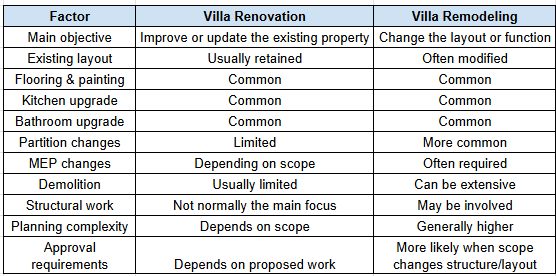
The important point is that renovation does not automatically mean cosmetic work, and remodeling does not automatically mean rebuilding.
The actual scope determines the complexity.
Examples: Is It Renovation or Remodeling?
Sometimes the easiest way to understand the difference is through real project situations.
Replacing Existing Flooring
If the villa’s layout remains unchanged and you’re replacing old tiles with new flooring, this is generally a renovation.
Repainting the Villa
Refreshing walls, ceilings and other existing surfaces is normally renovation work.
Replacing Kitchen Cabinets
If the kitchen layout remains the same and you’re replacing cabinets, countertops and finishes, it would generally fall under renovation.
Opening Up a Closed Kitchen
Removing a partition to connect the kitchen with the dining or living area moves the project toward remodeling, particularly if services or structural elements are affected.
Moving a Bathroom
Relocating a bathroom can involve new drainage, water supply, electrical and ventilation requirements. This is more than a surface upgrade and should be treated as a remodeling-level change depending on the scope.
Converting a Bedroom Into an Office
The physical room may already exist, but changing its function can require layout, lighting, electrical, flooring, ceiling or partition changes.
Upgrading MEP Systems
Replacing or upgrading electrical, plumbing or HVAC systems can form part of either renovation or remodeling. The classification depends on whether the existing arrangement is being upgraded or substantially reconfigured.
When Should You Choose Renovation?
Renovation may make sense when the existing villa layout already works for your lifestyle.
You may want to consider renovation when:
- The villa looks outdated
- Finishes are worn
- The kitchen needs upgrading
- Bathrooms need refurbishment
- Flooring needs replacement
- You want a fresh interior appearance
- Existing rooms are appropriately sized
- The current layout works for your family
- You want to improve the property without major reconfiguration
A well-planned renovation can make a significant difference without changing every part of the property.
When Does Remodeling Make More Sense?
Remodeling becomes more relevant when the existing layout is the problem.
For example:
- The kitchen is too small
- Bedrooms are poorly positioned
- There is insufficient storage
- The living and dining areas don’t work together
- You need a home office
- You want to combine rooms
- You need to relocate wet areas
- The villa no longer suits your family’s requirements
In these cases, simply changing finishes may not solve the underlying problem.
A remodeling project allows the property to be reconsidered from a functional perspective.
What About Approvals for Villa Renovation in Dubai?
This is an important consideration before starting any major villa project.
There isn’t one universal approval requirement that applies identically to every villa in Dubai. Requirements can depend on the community, developer, property type and scope of work.
Current Dubai renovation guidance indicates that work involving structural modifications, external changes, extensions or significant MEP changes may require additional approvals, while some straightforward interior upgrades can follow a simpler process. Community or developer requirements can also apply.
For this reason, villa owners should establish the scope before demolition or construction begins.
A contractor should be able to identify which parts of the proposed work need additional technical review or approval rather than treating every villa project in exactly the same way.
Renovation and Remodeling Can Be Combined
Your project doesn’t necessarily have to be one or the other.
A Dubai villa project can include both renovation and remodeling.
For example, a homeowner might:
- Repaint the entire villa
- Replace flooring
- Renovate the bathrooms
- Upgrade the kitchen
- Remove a partition
- Create an open-plan living area
- Upgrade electrical systems
- Improve lighting
- Add new joinery
The first group is largely renovation work, while the layout changes move the project into remodeling.
This is why defining the scope of work is more useful than focusing only on the label.
What Should You Check Before Starting a Villa Project?
Before selecting a contractor, look beyond the headline quotation.
1. Define the Scope
Write down exactly what you want to change.
A clear scope makes quotations easier to compare.
2. Check the Existing Property
Older villas may have hidden issues involving plumbing, electrical systems, waterproofing, HVAC or previous modifications.
These should be identified before finalizing the work wherever possible.
3. Understand the Layout
If your current layout works, renovation may be sufficient.
If the layout creates daily problems, remodeling may be worth considering.
4. Consider MEP Requirements
Electrical, plumbing and HVAC requirements can become particularly important when kitchens, bathrooms or room layouts are changed.
5. Confirm Approval Requirements
Don’t assume that because a project is inside your villa, every type of work can start without approval. Requirements depend on the property and proposed scope.
6. Get a Detailed Quotation
The quotation should make it clear what is included, which materials are specified and which works are excluded.
7. Understand the Execution Sequence
Renovation work should be properly coordinated. MEP, waterproofing, ceilings, flooring, joinery and finishing works need to happen in an appropriate sequence to avoid unnecessary rework.
How RenoFit Approaches Villa Renovation Projects
At RenoFit, villa renovation projects can involve multiple trades working together, from civil and MEP works to flooring, kitchens, bathrooms, ceilings, joinery and finishing.
The first step should be understanding the existing property and defining the actual scope.
From there, the project can be planned around:
Site Assessment → Scope Definition → Planning & Material Selection → Quotation → Approvals Where Required → Execution → Inspection → Handover
The exact process can vary according to the size and complexity of the project.
For homeowners looking for a villa renovation in Dubai, the goal should not simply be to make the property look newer. The renovation should also address functionality, workmanship, technical coordination and long-term use.
You can explore RenoFit’s Renovation services in Dubai to understand the renovation solutions available for residential properties.
Frequently Asked Questions
Is villa renovation the same as remodeling?
Not always. Renovation generally focuses on improving or updating an existing property, while remodeling usually involves changing the layout, configuration, or function of the space. A single project can include both.
Is remodeling more expensive than renovation?
It can be, particularly when remodeling involves demolition, layout changes, structural work, additional MEP work, or more extensive approvals. However, the actual cost depends on the property’s condition, scope, size, materials, and project requirements.
Can I change my villa layout during renovation?
Potentially, but the feasibility and approval requirements depend on what you want to change. Structural modifications, external changes, and certain MEP alterations may require additional technical review or approvals in Dubai.
Do villa renovations in Dubai require approval?
It depends on the scope and location of the villa. Cosmetic interior work can have different requirements from structural, external or major MEP modifications. Community or developer requirements may also apply. Confirm the requirements before work begins.
Can renovation and remodeling be done together?
Yes. Many villa projects combine renovation work such as flooring, painting and bathroom upgrades with remodeling work such as layout changes or partition modifications.
How do I know which option is right for my villa?
Start by identifying the problem you want to solve. If the existing layout works but the property needs updating, renovation may be appropriate. If the layout or functionality is the main issue, remodeling may be more suitable.
Final Thoughts
The difference between villa renovation and remodeling comes down mainly to the scope and level of change.
Renovation can refresh and improve an existing villa through new finishes, upgraded rooms, improved systems and better detailing. Remodeling goes further when the property’s layout, configuration or function needs to change.
For Dubai villa owners, the best starting point is not choosing a label. It is assessing the existing property, defining what needs to change and understanding the technical and approval requirements before work begins.
When the scope is clear from the beginning, it becomes much easier to plan the project, compare quotations and coordinate the work properly.